
Two weeks have passed since AWS re:Invent 2024, and the excitement has yet to fade. Attending my first-ever re:Invent was an extraordinary experience filled with learning, collaboration, and innovation. This article captures the highlights, learnings, and suggestions from this inspiring journey.
What I Did at re:Invent
1. Keynotes: Lori Beer’s keynote was a standout moment. As part of JPMorgan Chase (JPMC), it was inspiring to hear her articulate JPMC’s cloud journey with AWS. Her insights underscored the transformative role of the cloud in financial services and beyond. Additionally, I learned about:
- Compute: AWS announced the evolution of Trainium processors—Trainium 2 is available now, with Trainium 3 slated for next year. These processors are designed to accelerate AI/ML workloads, offering enhanced performance and efficiency.
- Storage: The introduction of S3 Table Buckets enables support for Iceberg tables, delivering 3x better query performance and 10x higher transaction rates. This makes managing and querying massive datasets seamless, especially in analytical scenarios.
- Databases: Amazon Aurora DSQL was a highlight, showcasing virtually unlimited scalability and faster distributed SQL capabilities. DynamoDB Global Tables now offer low-latency multi-region consistency, a critical feature for global applications.
- AI/ML: Amazon Bedrock launched several key features—responsible AI guardrails, multi-agent collaboration, latency-optimized inference, and Bedrock Knowledge Bases for retrieval-augmented generation (RAG). These features emphasize AWS’s commitment to responsible, scalable AI applications.
These announcements highlighted AWS’s focus on empowering organizations to innovate faster and more effectively.
2. Workshops & Labs: I participated in hands-on workshops and labs, including AWS JAM sessions and SimuLearn, gaining practical knowledge in simulated environments.
3. Collaborations: Conversations with AWS product teams about aligning QuickSight’s roadmap with JPMC’s needs were particularly fruitful. These discussions highlighted the importance of collaborative innovation.
4. Expo Highlights: The expo was a melting pot of ideas. Exploring cutting-edge solutions, engaging with startups and enterprises, and learning from passionate technologists were invaluable experiences.
5. Networking: Meeting experts from diverse industries showcased the breadth of AWS’s impact and its potential to solve unique challenges.
QuickSight Scenarios
AWS’s QuickSight Q Scenarios introduces a groundbreaking way for business analysts and decision-makers to interact with data and solve real-world challenges. This feature stands out as a transformational step in Business Intelligence (BI), making it more intuitive, accessible, and efficient.
Key Features and Benefits:
- Natural Language Interaction: QuickSight Q allows users to describe their business challenges in plain English, eliminating the technical barrier for non-technical users.
- Scenario Identification and Analysis: The system automatically identifies relevant data and recommends analytical approaches, streamlining complex workflows.
- Automated Insights: Based on user prompts, QuickSight Q performs advanced analyses and generates visualizations, delivering actionable insights in real-time.
- Personalized Dashboards: Users can easily transform insights into collaborative dashboards, making it simpler to share results and take action.
This capability opens the doors for a new audience in the BI domain—business managers, executives, and analysts who may not have technical expertise but need robust data-driven insights. By focusing on simplicity without compromising analytical depth, QuickSight Q bridges the gap between data and decision-making.
How It Solves New Domains of Use Cases:
- Scenario-Based Problem Solving: QuickSight Q empowers users to explore “what-if” scenarios, such as forecasting sales trends based on current inventory or analyzing customer churn. This enables proactive decision-making and risk mitigation.
- Accessibility for Non-Technical Users: With its natural language capabilities, even users unfamiliar with SQL or complex BI tools can harness the power of advanced analytics.
- Enhanced Collaboration: The integration of data scenarios with dashboards facilitates cross-functional teamwork, ensuring that insights are actionable and broadly understood.
- Reduction in Analysis Time: By automating data discovery and recommending next steps, QuickSight Q dramatically reduces the time needed to arrive at insights.
This feature has the potential to revolutionize BI by making sophisticated analytics tools available to everyone in an organization, not just data teams or BI professionals. QuickSight Q Scenarios promise to unlock creativity, innovation, and efficiency in tackling business challenges.
To learn more, check out AWS QuickSight Documentation and watch this detailed video introduction.
Workshop Experiences
1. Lightsail WordPress Hosting: In this workshop, I set up and hosted a WordPress website in less than 30 minutes using Amazon Lightsail. The experience demonstrated the platform’s simplicity and efficiency. With its predictable pricing, pre-configured applications, and automated snapshots, Lightsail emerges as an excellent alternative to traditional hosting providers like GoDaddy. It’s especially appealing for small businesses and personal projects looking for cost-effective and scalable solutions.
2. E-commerce Search Application with OpenSearch and Bedrock: Another hands-on session involved building an e-commerce search application leveraging foundational models. Using OpenSearch for indexing and Bedrock for AI capabilities, I implemented neural search and hybrid search approaches to improve search relevance and accuracy. This practical experience highlighted the seamless integration of foundational models with OpenSearch to deliver tailored, context-aware search results for complex applications.
3. Mergers and Acquisitions Use Case with Advanced QuickSight: In the final workshop, I tackled a complex scenario involving mergers and acquisitions. Data from two companies were streamed into DynamoDB, where entity recognition and deduplication were handled using AWS Entity Recognition. The deduplicated data was indexed in OpenSearch, and a retrieval-augmented generation (RAG) model was built using Bedrock to provide a chat-based application for users. To conclude, I created visualizations using Advanced QuickSight and QuickSight Q, offering insights into the combined dataset. This hands-on exercise demonstrated AWS’s ability to handle intricate workflows with efficiency and scalability.
Visual Workflow
To better illustrate the workflow for the mergers and acquisitions use case, here are the key steps with corresponding diagram references:
- Data Sources: Customer and product data from Aurora databases, documentation from Glue, and ticket data.
- Data is streamed into Amazon S3 as a raw zon

- Data is streamed into Amazon S3 as a raw zon
- Processing: Deduplication via AWS Entity Resolution and indexing into DynamoDB.
- Data flows through various AWS services for preparation.
- Vector Embeddings: Using Bedrock to generate vector embeddings for enhanced search and retrieval capabilities.
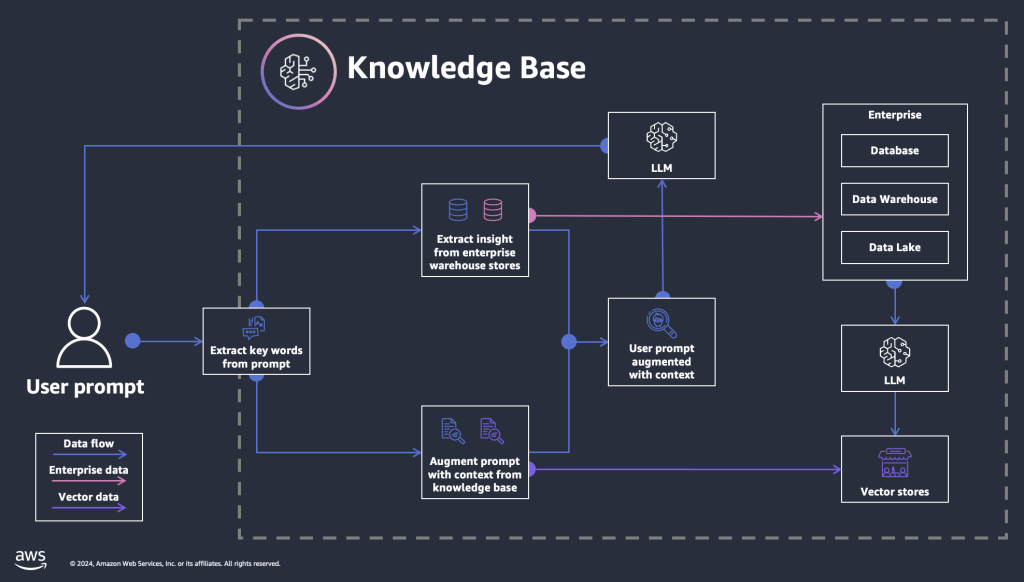
- Data Search and Visualization: Data is indexed in OpenSearch, integrated with Bedrock RAG models, and visualized in QuickSight.
- Real-time search and analytics capabilities enhance user experience.
- Chat Applications: Anthropic Claude and AWS Lambda functions were utilized to enable natural language interactions and real-time analytics for decision-making.
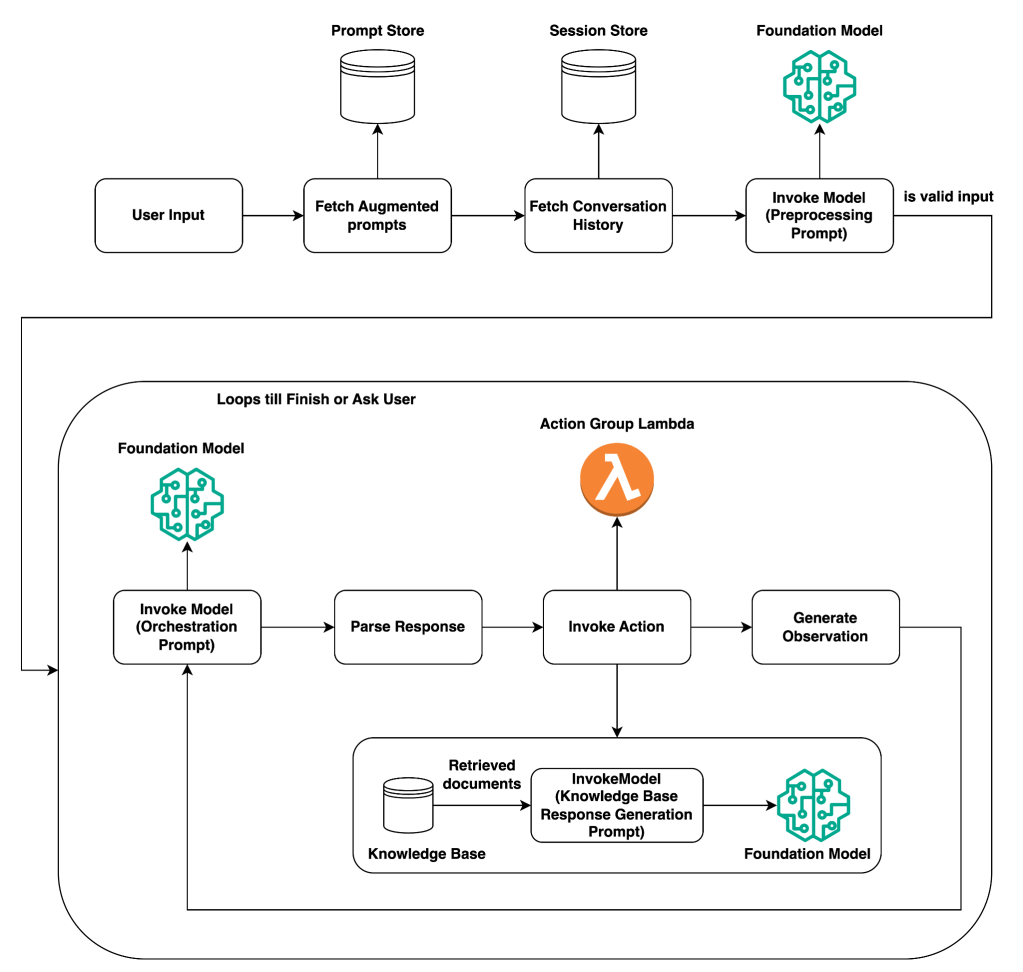
These diagrams provide a clear understanding of the end-to-end process and showcase the seamless integration of AWS services to address real-world challenges in data processing and analytics.
Announcements That Stood Out
Post-workshop, I reflected on the numerous announcements that demonstrate AWS’s relentless innovation, particularly in the data and AI/ML domains:
- Amazon Bedrock Enhancements:
- Guardrails: Improved responsible AI features, reducing hallucinations and ensuring safety in generative AI applications.
- Multi-Agent Collaboration: Agents working in parallel to orchestrate complex tasks without intricate coding.
- Latency-Optimized Inference: Faster processing speeds to meet real-time demands.
- Knowledge Bases: Fully managed RAG capabilities that natively query structured data and integrate with relational databases.
- SageMaker Advancements:
- SageMaker HyperPod: Introduced advanced resiliency and dynamic provisioning capabilities, enabling cost-effective utilization of ML training resources.
- Partner Integrations: AI partner apps can now be securely deployed and managed within SageMaker.
- Unified Studio: Enhanced user experience with built-in data cataloging and comparison chat for efficient ML workflows.
- Amazon Q Innovations:
- Q Developer Tools: Streamlining code quality with unit test generation, code reviews, and accurate documentation.
- Migration Support: Facilitating transformations for VMware workloads, mainframe applications, and .NET environments.
- AI and ML Ecosystem:
- Amazon Nova: A suite of foundational models catering to text, image, video, and multimodal use cases. Nova’s offerings provide cost-effective solutions tailored for diverse workloads.
- Bedrock Marketplace: An expansive collection of over 100 emerging models, giving enterprises the flexibility to choose the right AI tool for their needs.
These innovations resonate deeply with me as they align with the growing need for scalable, reliable, and intuitive AI-driven solutions in modern enterprises.
What I Liked About re:Invent
- QuickSight Q Scenarios: Revolutionizing analytics by enabling intuitive, natural language data exploration.
- Lori Beer’s Address: A proud moment reflecting JPMC’s success in leveraging AWS’s capabilities.
- AWS’s Unified Data/AI Vision: The push toward becoming a consolidated platform for AI-driven insights, competing with leading data warehouses and lakehouses.
- Collaborative Ecosystem: The passion of technologists solving unique challenges was truly inspiring.
- AWS Industry Solutions: Simplifying complex problems while empowering innovation across startups and enterprises.
Suggestions for Future re:Invents
While AWS re:Invent 2024 was exceptional, here are some ideas to enhance future experiences:
- Interactive Challenges: Introduce fun AWS-themed quizzes and challenges to foster learning and interaction.
- Streamlined Keynotes: Improve the flow of keynote announcements for a more cohesive narrative.
- Problem-Driven Sessions: Focus more on real-world problems and how AWS solutions address them.
- Hands-On Demos: Provide free environments for attendees to explore new features firsthand.
- Gamify Architecture Design: Create interactive games similar to GameDay but tailored for solution architects.
- AI Chatbot Assistance: Develop chatbots to guide attendees with schedules, locations, and personalized recommendations.
Summary
AWS re:Invent 2024 was a truly transformative experience. The event highlighted AWS’s ability to adopt revolutionary research and reimagine it to benefit its customers, making complex technologies accessible and actionable.
Key highlights include the QuickSight Q Scenarios, which bring advanced analytics to non-technical users, and enhancements in Bedrock, SageMaker, and Amazon Q, showcasing AWS’s focus on democratizing AI/ML and driving innovation. From hands-on workshops to networking with technologists solving real-world problems, every moment reinforced AWS’s role as a leader in empowering businesses to innovate.
Disclaimer: These reflections are solely my own and do not represent the views of JPMorgan Chase.
Let’s continue to re:Invent the future together! 🚀
 Sudheer Talluri
Leave a comment